
Endometriosis is a medical condition where tissue similar to the uterine lining is present outside the uterus in the abdomen, pelvis, or other areas in the body. The uterine lining is called endometrium (“metri” means uterus, and “endo” refers to inside lining). Endometriosis (“endometri” refers to endometrium, “osis” means medical condition).
Endometriosis grows in response to estrogen. Endometriosis can grow on the lining of almost any body cavity but most commonly occurs in the abdominal cavity (peritoneum). It can move deeper to invade or affect underlying organs. This can lead to not only significant pain but any number of system dysfunctions (i.e. bladder, bowel, nerve, etc).

Ablation uses heat or energy to burn the surface of endometriosis lesions, but can often leave disease behind, cause damage to normal nearby tissue, and/or make pain worse.
Excision, on the other hand, involves cutting out endometriosis tissue at its root, allowing for more specific and more thorough treatment.
Endometriosis is a diagnosis that can only be confirmed by looking surgically, this is usually accomplished with laparoscopy. This means it cannot be definitively diagnosed by taking your history, physical examination, blood or urine tests, x-rays, ultrasounds, MRI, or CT scan.
Laparoscopic excision allows the physician to diagnose endometriosis through tissue testing, even when it’s not clearly visible. While there are different surgical options, Dr. Lucas prefers excision for its precision and effectiveness in relieving pelvic and sexual pain.
If you’ve been told you have endometriosis, please let us know. The surest way to diagnose endometriosis is through surgery, which we can perform as an outpatient procedure. This may afford us the ability to treat the lesions at the same time, offering a comprehensive approach to managing your endometriosis and associated symptoms.
Endometriosis often implants close to, or directly over, vital structures, such as the ureter. Destructive techniques may pose a safety threat to underlying structures. When a physician looks in the abdomen during laparoscopy, and the patient is found to have endometriosis, the doctor can try to destroy the lesions (laser vaporization or burning the lesions with electrical cautery – “fulguration”) or excise them (going around, underneath, and completely removing the tissues that are hurting you).
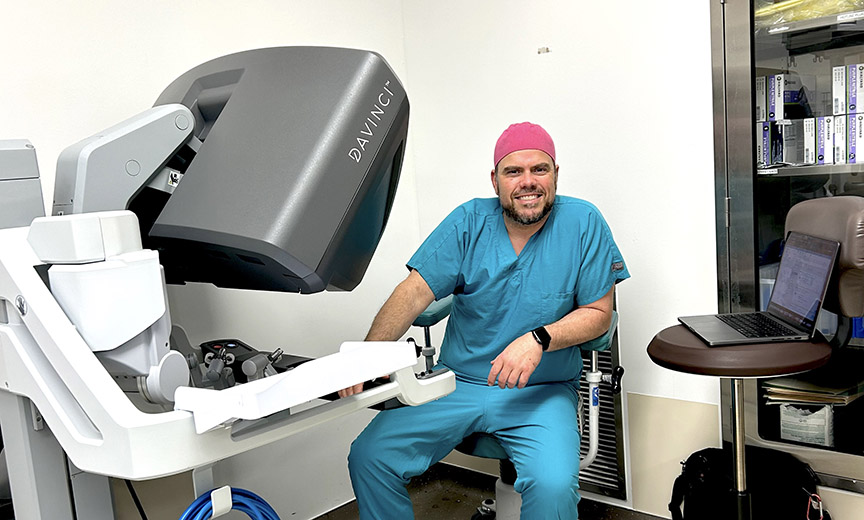
Dr. Lucas has achieved a Focused Practice Designation in Minimally Invasive Gynecologic Surgery from the American Board of OB/GYN, highlighting his commitment to providing advanced care for sexual pain and pelvic health in New England. He has performed over 500 documented robotic surgeries on the daVinci platform.
Dr. Lucas, a pelvic pain specialist in Freeport, ME, focuses on fully removing endometriosis and affected tissue with precision. When needed, he collaborates with other surgeons to treat areas beyond gynecologic scope, demonstrating his expertise across Maine and New England.
All specimens are sent for microscopic confirmation, and photo documentation is taken at the time of surgery. At the post-operative visit, patients receive a complete record—including photos, operative notes, and pathology reports—ensuring a transparent and informed recovery process.
Endometriosis will respond to the hormone estrogen and can cause pain with menstrual cycles, pain with sexual intercourse, infertility, and unrelenting chronic pelvic, back, hip-and leg pain. Not everyone has every symptom but, most sufferers have multiple symptoms and dysfunctions. Endometriosis is a factor in up to 40% of cases of unexplained infertility.
Endometriosis affects 10-15% of the female population.
Endometriosis is primarily a surgical diagnosis. This means it cannot be definitively diagnosed by taking your history, physical examination, blood or urine tests, x-rays, ultrasounds, MRI, or CT scan. A diagnosis can be presumptive and interventions can initially be attempted with medication to alter hormones in order to alleviate symptoms.
While imaging like ultrasound or MRI can be helpful with surgical planning, they are diagnostic. Additionally, there are now blood, saliva and tissue tests that are showing promise for diagnosis before surgery but this is emerging technology.
2 key points to remember about Endometriosis:
1) There is no correlation between the symptoms the person is experiencing and whether endometriosis is present. (You may have severe cyclical pain that seems like it is endometriosis, but it is not).
2) There is no correlation between the severity of the symptoms and the extent of endometriosis present. (You may have extensive endometriosis and have pain that is tolerable or managed by medical interventions. Conversely, you may have only a few endometriosis lesions and experience debilitating pain with periods.)
See Dr. Lucas!! There are hundreds of options to alleviate symptoms until definitive surgical intervention. This is a very specific question because only YOU know your endometriosis pain experience. Dr. Lucas will work with you to develop a plan of care to address your pain until surgical intervention is needed, available and/or desired.
These options can range from oral medicine to compounded medicine to manual medicine to acupuncture, the list goes on. The same pain care regimen will not work for everyone so we have a wide spectrum of treatment options available.
(CAUTION: Hardcore Science-y stuff ahead. But it is very useful to understand.)
Every organ has different tissue types. Each tissue type within an organ can produce tumors, benign and malignant.
The ovary has 3 tissue types:
1) Eggs and follicles (aka cysts) produce germ cell tumors
2) Connective tissue (aka the tissue that holds the ovary together) produce stromal tumors
3) Epithelial tissue (aka covering over the outer surface of the ovary) produce epithelial tumors. Approximately 70% of all ovarian tumors are epithelial. Epithelial tumors can be serous, mucinous, clear cell, or endometrioid.
These subtypes are based on how the tumors look under the microscope.
There is evidence in the medical literature that clear cell and endometrioid ovarian tumors may develop from endometriosis. Literature review shows only a mild association between endometriosis and the development of ovarian cancer. The relationship of endometriosis and ovarian cancer is not confirmed.
A literature review published in early 2014 using the keywords “endometriosis” and “ovarian” found 1 prospective cohort study, 10 retrospective cohorts, and 5 case-control studies. All of these studies, except for one, did not include operative confirmation of endometriosis. Authors found a consistent association between endometriosis and clear cell and endometrioid cancer, but the authors concluded that the association linking endometriosis and ovarian cancer is not sufficient to impact current clinical practice.
Therefore, to summarize what is known at this time, there is an association between epithelial cancers of the ovary and endometriosis, but there is currently not enough evidence to warrant alteration in endometriosis treatment.
Pain is always real. Often, we can find what is causing the pain. In many of these patients, we can alleviate the pain. When the source of the pain is not immediately found, we work to exclude the most deleterious diagnoses at first. A klist of possible diagnoses is generated and then we sequentially rule out diagnoses until we have a more specific idea s to the cause and thus, a clearer picture of what can help.
Endometriosis can present as menstrual pain, pain intermittently throughout the month, or continuous pain. Response, or lack of response, of symptoms to medications, such as hormonal modifiers and contraceptives does not necessarily rule in or rule out the presence of endometriosis. However, they can help to identify when the cause of the pain is hormone dependent.
Abdominal, pelvic, back pain can have many sources, including but not limited to musculoskeletal dysfunction/spasm, vascular insufficiency, endometriosis, pelvic inflammatory disease (PID), interstitial cystitis (IC; now known as Painful Bladder Syndrome), inflammatory bowel diseases (IBD), irritable bowel syndrome (IBS; now known as Disorder of the Gut-brain Interface/Axis), and neurologic dysfunction.
Pelvic floor muscles respond to chronic pain conditions. Even if endometriosis is thoroughly removed, some patients need physical therapy/biofeedback. Manual therapy (Osteopathy, physical therapy, acupuncture, massage, etc) has a better chance of being successful after the underlying cause for the pain is removed. To have the best chance for pain relief, we need to treat the whole person and eliminate as many sources of pain that we can identify.
Sometimes after laparoscopic excision, some, most, or all the specimens are positive for endometriosis on pathology, but the patient still has pain. In that individual, there may be another factor at work that is causing her pain. We now know and understand that pain responses change over time. Literally, the nerves change to become easily excitable and more likely to send pain signals to the brain, even when there is no actual damage being done to tissue. This is called Central Sensitization. This is a complex disease entity but there are options to treat it. This is a major reason why, if you continue to have pelvic pain after having had surgery: